Goddess of Victory: Nikke Tier List — A Real Player’s “Who’s Worth Building” Guide (Story, Bossing, PvP)
If you’ve played Goddess of Victory: Nikke for more than, like, two days, you already know the uncomfortable truth: this game is not just “pick your favorite waifu and win.” You can do that for a while, sure… right up until the Campaign starts punching you in the teeth, bosses turn into DPS checks with mechanics, and PvP reminds you that other people have hands and wallets.
So this is my player-to-player tier list guide—the kind you’d want if your friend leaned over and said:
“Okay, I’m not trying to whale. I just want to stop wasting resources. Who do I build, who do I reroll for, and what teams actually work?”
Also: tier lists in Nikke are weird compared to a lot of gachas because:
Some units are universally cracked (they fit almost anywhere).
Some units are “mid” until they hit a specific team shell, then they become monsters.
Some units are incredible… but only if you’re willing to manual, invest heavily, or have the right supports.
And yeah—since this is about the tier list, we’re focusing on practical strength: Campaign consistency, boss damage, survivability, team enabling, and how painful they are to build.
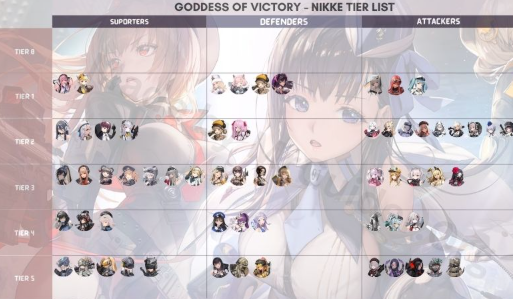
I. What This Tier List Is Actually For (And Why Version Meta Matters)
A. What Nikke really is (under the hood)
At first glance, Nikke looks like a cover shooter with cute characters and flashy ultimates. Under the hood, it’s basically a team-building puzzle where you juggle:
Burst rotations (Burst I → Burst II → Burst III),
cooldown reduction (CDR),
survival tools (heals, shields, invincibility, cover repair),
and damage windows (big burst timing, weakpoint uptime, add clearing).
You’re not just picking “strong units.” You’re building a machine that cycles Burst smoothly and doesn’t fall apart when a stage starts spamming missiles and elite mobs.
B. Why character selection matters so much in endgame
In early Campaign, you can brute force with levels. Later on, you hit walls where:
your team dies too fast (even when you “should” have enough power),
your Burst rotation feels slow and janky,
or you simply can’t kill priority threats fast enough.
That’s where “enablers” (like top CDR supports) stop being optional and start being your whole account.
C. Why tier lists change (and why you shouldn’t panic every patch)
Nikke meta shifts mostly because of:
new characters introducing busted mechanics,
balance changes,
new modes and boss gimmicks,
and players discovering new team tech.
But here’s the calming truth: the best supports stay useful forever, and most accounts benefit more from building a stable core than from chasing every shiny new DPS.
II. Tier System Explained (T0, T0.5, T1, T2…) Like a Human Would Explain It
A. T0 = “If you own this, your account just got easier”
These are characters with:
near-irreplaceable kits,
insane flexibility,
or “I solve entire problems by existing” mechanics.
They’re not always the highest raw DPS. They’re the ones that make everything else work.
B. T0.5 = “Almost T0, but needs the right context”
These units can be T0-level in:
a specific team,
a specific mode (bossing vs PvP),
or with certain investment.
They’re still amazing—just not always plug-and-play.
C. T1 = “Strong, reliable, and doesn’t ruin your resources”
T1 is where most good accounts live. These characters:
clear content,
scale well,
and often act as the best substitutes when you don’t own the top monsters.
D. T2 and below = “Useful sometimes, but don’t build your whole life around them”
T2 units might be:
early-game carries,
niche counters,
or “insane if you invest too much and manual perfectly.”
But if you’re asking “who should I max first,” most T2s are not the answer.
E. What I’m actually ranking by (the stuff you feel in gameplay)
I’m weighting:
Consistency (do they work in messy fights?),
team enablement (do they make other units better?),
survivability impact (do they prevent random wipes?),
ease of building (can a normal player make them good?),
and mode coverage (Campaign + bossing + PvP value).
III. T0 Story/Campaign DPS Characters (The “Carry Me” Damage Dealers)
This section is for the units that make Campaign feel like you turned down the difficulty slider. Some of them are burst nukers, some are sustained monsters, and some are just “I delete adds and bosses while you blink.”
A. Scarlet: Black Shadow — the “screen gets deleted” Burst DPS
If you’ve ever watched a stage that normally overwhelms you just… evaporate, it’s usually because Scarlet: Black Shadow pressed Burst at the right time.
Why she’s T0 in Campaign:
She excels at wave control, which is the real Campaign killer.
She turns messy fights into clean fights by deleting threats before they execute their gimmicks.
She scales brutally when you’re fighting under power (which is basically everyone pushing story).
How she feels to play:
You rotate Burst, line up the moment mobs stack, and the screen goes “nope.”
She’s especially satisfying when stages spawn those annoying backline threats that normally force you to scramble.
Where she can feel less perfect:
In some boss scenarios, “clean wave clear” matters less than “single-target uptime.”
She still performs, but some boss specialists can edge her out depending on mechanics and your team.
B. Modernia — the “sustained boss shredder who also clears” machine gun queen
Modernia is basically the unit you bring when you want:
consistent DPS,
strong boss pressure,
and reliable value without needing galaxy-brain timing.
Why she’s T0:
She’s one of those characters that feels strong even when your account is scuffed.
Her damage profile is steady, which means fewer “oops my burst window got messed up” moments.
She’s also ridiculously good for “I need this thing dead, now” situations.
Modernia’s biggest advantage:
You don’t have to build your entire team around her for her to feel useful.
She just… works.
C. Red Hood (Rapi) — the “newcomer’s godsend” that stays good forever
Red Hood is famous for a reason: she gives you that feeling of “my account is online” earlier than most units do. She’s also one of those DPS options that doesn’t fall off the moment you leave early game.
Why she’s so valuable:
Strong damage output, good scaling, and a kit that plays nicely with common support setups.
She’s a “build me and don’t regret it” kind of unit.
D. Little Mermaid (Siren) — the Burst I DPS unicorn (weird but real)
In most gachas, Burst I slots are “support tax.” Nikke is no different—except when you have a Burst I unit that actually contributes meaningful damage while still doing Burst I things.
That’s why Little Mermaid (Siren) stands out:
She gives you damage from a slot that’s normally “pure utility.”
That can smooth out Campaign runs when your Burst III carry isn’t enough on their own.
E. Harran — the classic “solid sub-DPS / sniper pressure” pick
Harran is one of those characters who doesn’t always get the loudest hype anymore, but in practical play:
she remains a very dependable damage contributor,
can help control key threats,
and fits nicely when you need a second damage source that’s not greedy.
She’s not always your “main carry,” but she’s often the glue that makes your clears consistent.
IV. T0 Support and Enabler Characters (The Real Reason Your Team Works)
If you only remember one thing from this whole guide, make it this:
DPS comes and goes. Supports that enable Burst rotation and survival are forever.
A. Liter — the gold standard support (damage amp + CDR + comfort)
Liter is the kind of unit that makes you feel like you’re cheating, because suddenly:
your Burst rotation feels smoother,
your team hits harder,
and your run stops falling apart from random nonsense.
Why she’s T0:
She compresses multiple jobs into one slot: buffing, cooldown help, and general team stability.
You can put her into a ridiculous number of teams and she’ll still be correct.
Liter is also the classic “reroll target” because she upgrades your entire roster, not just one team.
B. Crown — the “5 seconds of invincibility” problem-solver
Crown is the unit you bring when you’re tired of losing runs because:
one bad missile,
one poorly-timed elite attack,
or one chaotic wave
deleted your team before you could stabilize.
Invincibility in Nikke isn’t just defensive—it’s offensive, because it lets you keep firing through danger instead of hiding and losing DPS uptime.
That’s why Crown is so valuable: she doesn’t just “heal back damage.” She prevents the wipe in the first place.
C. Nayuta — big healing, damage amplification, and “make waves manageable”
Nayuta shows up as a top-tier support because she’s not only keeping you alive—she’s also pushing your output and helping stabilize fights where adds spiral out of control.
In real player terms:
Your team lives longer.
Your damage feels higher.
Your clears become less RNG.
That combination is exactly what makes a unit “T0 support.”
D. Dorothy — bossing specialist support who makes your numbers pop
Dorothy is one of those supports that shines brightest when the content becomes:
single-target heavy,
mechanic-driven,
and all about optimizing damage windows.
She’s not always the “most comfy” Campaign support compared to pure safety picks, but for bossing, she can be absolutely disgusting in the right setups.
V. T0.5 and T1 Supports (When You Don’t Own the Perfect Units)
Not everyone has Liter + Crown + top Pilgrims just sitting in their box. So here’s the good news: Nikke has several supports that can carry you hard even if you’re missing the holy grails.
A. Pepper — strong healing and functional support value
Pepper is the kind of healer that feels great because:
she stabilizes early and mid game,
she’s straightforward,
and she helps you survive the messy parts of Campaign where you’re still learning mechanics.
She’s not always the most “endgame optimized” compared to the absolute best, but she’s extremely real-account friendly.
B. Rapunzel — revive mechanics = forgiveness
Rapunzel is basically the “training wheels but in a good way” healer.
Her revive can turn a failed run into a clear.
She’s especially nice when you’re pushing under power and small mistakes normally mean instant death.
C. Centi — early-game shield MVP (and still useful later)
Centi has that “my team suddenly stops dying” effect, especially when you’re still building gear and levels.
Shields buy time.
Time buys Burst rotations.
Burst rotations win fights.
D. Mast (Maid) + Anchor (Maid) synergy — bursty team tech
Some units become much better when paired. The Maid synergy is one of those “team packages” where:
together, they unlock a performance spike that feels unfair compared to running them separately.
If you’re building around them, they can punch above their individual tier placement.
VI. T1 Sub-DPS and Hybrids (The Flex Picks That Make Teams Feel Complete)
A. Privaty — stun + AoE = “Campaign comfort”
Privaty is a common recommendation because she’s useful in the situations that matter:
waves,
annoying elites,
and moments when you need control to prevent getting overwhelmed.
She doesn’t need a galaxy-brain setup. She just works.
B. Dolla — survival support with defensive value
Dolla brings a mix of utility that can be clutch when your team is fragile.
In Nikke, preventing a wipe is sometimes more important than adding 5% more DPS.
C. Admi — reload speed and sustained value
Admi’s strength is that she can make certain DPS characters feel smoother and more consistent. If your carry relies on sustained uptime, reload-related boosts can be a bigger deal than people expect.
D. Drake — high-value damage that scales with account growth
Drake is one of those “I built her early and she never felt like a waste” units for a lot of players.
She’s not always the absolute best-in-slot at the top end, but she’s extremely reliable.
VII. T2 and Lower (Transitional, Niche, or “Good But Expensive”)
This is where the tier list gets spicy, because some of these units can be amazing… but only if you’re willing to invest heavily or play manually.
A. Alice — absurd single-target ceiling at high investment
Alice is the poster child for:
“This is incredible when built right,”
and “This feels mediocre if you half-build it.”
If you’re the kind of player who loves optimizing and doesn’t mind investing, Alice can pay you back. If you want quick results with minimal pain, she’s not always your first pick.
B. Cinderella — boss specialist with nasty scaling
Boss specialists tend to rise and fall depending on:
current boss mechanics,
how your account handles survival,
and whether you have the supports to keep them firing.
Cinderella can be a monster in the right context, but she’s not always as universally comfy as T0 carries.
C. Snow White — high ceiling, manual-heavy
Snow White is famous for big numbers, but she often asks you to:
play more carefully,
invest more,
and accept that she’s not always “brain-off” like Modernia.
D. Maxwell and other early-game useful units
Some characters are “great when you’re starting out” but become less exciting later unless they fill a specific role in your roster.
E. N102 — the starter that does the job
N102 exists in a lot of accounts as that “okay, you’re not terrible, you’re just temporary” support. Build enough to progress—then replace when you can.
VIII. Burst System and Energy Mechanics (The Part That Makes New Players Suffer)
If your team feels bad, it’s often not because your DPS is weak. It’s because your Burst rotation is scuffed.
A. Burst I: utility, healing, CDR, setup
Most of the time, Burst I slots are where you put:
your healer,
your CDR engine,
or your “keep the run stable” unit.
This is why units like Liter are so stupidly valuable: Burst I is a mandatory slot, so a powerful Burst I is basically a free win.
B. Burst II: shields, defense, control, survival tricks
Burst II is often where the “don’t die” magic happens:
shields,
invincibility,
defensive buffs,
cover support.
If you’re wiping a lot, your Burst II slot is usually the first thing to audit.
C. Burst III: the damage
Burst III is where your carry lives. Most teams run multiple Burst III units because:
you want consistent damage,
you need add clear,
and you need the flexibility to deal with different stage threats.
D. Cooldown reduction = your team’s heartbeat
A team with good CDR feels like a sports car. A team without it feels like pushing a shopping cart uphill.
IX. Roles and Squad Composition Framework (How You Stop Building Random Stuff)
Here’s the simplest “don’t grief your account” framework:
A. Main DPS
Your Burst III carry. Your “if this unit is dead, the run is over” character.
B. Offensive support
Buffs that directly increase damage:
ATK boosts,
Crit boosts,
damage amplification,
reload/uptime improvements.
C. Defensive support
Stuff that prevents wipes:
shields,
damage reduction,
invincibility,
damage sharing.
D. Healers
Not just raw healing—also reliability. Some healers heal constantly. Some heal in bursts. Some heal and bring extra value.
E. Energy/CDR support
These are the hidden kings. They don’t look flashy, but they make your whole team stronger.
F. Taunt tank (when relevant)
Not every team needs a taunt tank, but when content is targeting your backline, taunt mechanics can save your life.
X. Optimal Team Formation (Practical Team Templates You Can Actually Use)
A. The classic “1-2-3-3-3” concept
Most stable general teams look like:
1 Burst I support
1 Burst II survival/support
3 Burst III damage dealers / flex slots
Why this works:
You meet rotation requirements.
You have survivability.
You have damage coverage.
B. All-purpose Campaign shell (example logic)
A strong Campaign core often looks like:
Burst I: top enabler (CDR + buffs)
Burst II: “don’t die” unit (shields/invincibility)
Burst III: one carry + add clear + flex
If you own T0 supports, you’ll feel the difference immediately because the team’s “baseline stability” becomes way higher.
C. Specialized synergy teams (like Maid tech)
If you’re building synergy teams, commit properly:
invest in both parts of the package,
tune the rotation,
and don’t expect half-built synergy to outperform universal meta supports.
D. Budget variants
If you’re missing a key T0 unit, the goal is not “perfect meta.” The goal is:
stable Burst rotation,
enough healing/shielding,
and a carry that can actually finish fights.
That’s how you progress without feeling stuck.
XI. Early-Game Progression and Resource Allocation (How Not to Brick Your Account)
A. Prioritize supports that scale forever
If you’re unsure who to invest in, invest in:
universal supports,
healers with strong utility,
and defensive units that stop wipes.
DPS units can be replaced. Your support core stays relevant.
B. Don’t overbuild five different DPS
This is the classic trap:
You build every shiny damage dealer you pull.
You run out of skill materials.
You end up with five half-built characters that all feel mediocre.
Pick one main carry, then build the team that makes them good.
C. Skill upgrades matter (a lot)
In Nikke, skill levels are not optional. A “strong unit” with uninvested skills often performs like a mid unit.
D. Gear is the multiplier
If you’re comparing two accounts, the one with better gear and proper stats will often outperform the one with “better characters” but sloppy builds.
XII. Content-Specific Tier List Thinking (Campaign vs Bossing vs PvP)
A. Story/Campaign ranking = consistency + wave control + survival
Campaign loves:
AoE,
crowd control,
stability,
and defensive tech that prevents random wipes.
B. Bossing ranking = single-target uptime + burst window optimization
Bossing loves:
sustained damage,
weakness exploitation (where applicable),
and supports that increase uptime and damage amplification.
C. PvP ranking = speed, control, survival, and “who moves first”
PvP tends to reward:
turn/burst tempo,
control effects,
survival mechanics (invincibility, revive),
and shutting down key threats before they act.
XIII. Reroll Strategy (Realistic, Not Copium)
Let’s be honest: rerolling in Nikke is only worth it if you’re the kind of player who can handle repetition without tilting.
A. Reroll method: Gmail “plus addressing”
This is the clean method:
You can reuse one Gmail by appending +something.
Example:
yourname@gmail.com,yourname+2@gmail.com
It’s basically a way to make multiple “unique” logins without making multiple emails.
B. Guest account rerolling (device reset approach)
Some players reroll by using guest accounts and clearing data to restart. I’m not going to give sketchy “exploit” steps—just keep it within normal account reset behavior and don’t do anything that risks your account.
C. Best reroll targets (practical order)
If I’m rerolling, I’m prioritizing:
Top universal enabler supports (because they scale forever)
One top DPS carry (because progression needs damage)
Survival tech (because wipes waste time)
If you hit “great support + great carry,” you’re basically set.
D. Minimum viable starting team
You don’t need perfection. You need:
one carry you’ll invest into,
one stable Burst I,
one stable Burst II,
and enough damage coverage to clear waves.
XIV. Investment Tiers by Game Phase (Week 1 vs Week 8 feels like different games)
A. Early game (Week 1–2)
Build whoever clears story reliably.
Don’t obsess over perfect meta.
Focus on one carry and basic supports.
B. Mid game (Week 2–8)
Start building a real core team.
Begin investing in the supports you won’t replace.
Prepare for mode specialization (bossing vs Campaign).
C. Late game (Week 8+)
Now you optimize rotations, gear, and team packages.
You build specialized teams for boss scoring and PvP matchups.
D. Hyper-carry builds (for players chasing top scores)
If you’re going hard, you’ll eventually build:
a bossing team,
a wave-clearing team,
and PvP shells.
But don’t do that until your foundation is stable.
XV. Synergy and Why Tier Placement Changes by Mode
A. “Enablers” vs “Carries”
A carry is the one doing damage.
An enabler is the one who makes the carry function at a higher level.
In Nikke, enablers often matter more than carries because:
one good enabler can boost multiple carries,
while one carry is just… one carry.
B. Survival first, then damage optimization
If your team dies, your DPS is zero. This is why invincibility/shield/heal tech often ranks higher than people expect in Campaign tiering.
C. Build around mechanics, not just “power”
Some units look strong on paper but feel awkward because:
they don’t fit your Burst timing,
they compete for the same slot,
or they require teammates you don’t own.
That’s why tier lists are guidelines, not commandments.
XVI. Frequently Asked Questions
A. Who should I reroll for as a beginner?
If you’re going to reroll at all, aim for a top universal support first, then a top carry. Supports age better than DPS.
B. Can lower-tier characters work in endgame?
Yes—especially with strong gear and supports. But if you’re trying to save resources, prioritize units that stay relevant across modes.
C. What matters more: gear or character power?
Both matter, but gear and skill upgrades are the difference between “this unit is fine” and “this unit is cracked.”
D. How often does the meta change with balance patches?
It shifts regularly, but the core truth stays: universal supports and survival tools remain valuable long-term.
XVII. Latest Patch Updates and Character Balance (Why You Should Keep One Eye on Updates)
Nikke does adjust balance and introduces new characters and mechanics over time, which is why you’ll see tier list sites update frequently. In practice, most players shouldn’t rebuild their entire roster every patch—just:
watch for major support releases,
note if your main carry gets buffed/nerfed,
and adapt your pulls accordingly.
XVIII. Strategic Positioning and Mental Models (How to Think Like a Good Nikke Player)
A. Build your foundation first
If your account has:
one strong Burst I enabler,
one strong Burst II survival tool,
and one strong Burst III carry,
you will progress. Everything else is refinement.
B. Fix the reason you’re losing
Are you wiping? Add survival.
Are you timing out? Add damage or optimize rotation.
Are you overwhelmed by adds? Add wave control / AoE.
C. Don’t chase “tier” if it doesn’t fit your roster
A top unit that doesn’t fit your account can feel worse than a “lower tier” unit that perfectly matches your supports and gear.
D. Invest like you want to still enjoy your account in 3 months
The best feeling in Nikke is when you look at your roster and think:
“Yeah, no matter what mode pops up, I’ve got a team for that.”
That’s the real endgame.
If you want my honest player verdict: Nikke tier lists are less about flexing who’s “SSS” and more about building a roster that doesn’t waste your time.
T0 supports are the engine of your account.
T0 carries make Campaign and bosses feel possible instead of miserable.
T1 units are where most smart players live—strong, flexible, and resource-efficient.
T2/niche units can be amazing, but only when you understand why you’re building them.
So if you’re deciding what to do next, here’s the simplest checklist:
Lock in a stable Burst rotation (I → II → III).
Invest in at least one universal support that scales forever.
Pick one main DPS carry and actually commit.
Add survival until wipes stop happening.
Then optimize for bossing/PvP once your foundation is solid.
And yeah—when you hit that moment where your team stops feeling like five random characters and starts feeling like a machine? That’s when Nikke gets really fun.